Saturday, January 21, 2012

NETWORK (SIDNEY LUMET, 1976)

Network, USA, 1976
Dir: Sidney Lumet
Cast: William Holden, Peter Finch, Faye Dunaway


"All necessities provided. All anxieties tranquilized. All boredom amused."


Have people forgotten about this movie? Network, directed by the legendary Sidney Lumet, is a classic that remains as timely and relevant today as it was four decades ago. The film was released theatrically during a time when America was recovering from a war overseas, the resignation of President Richard Nixon due to the Watergate scandal, and a nation undergoing a recession that mimics the one the U.S. is currently in.

Written by Paddy Chafeysky, one of Hollywood’s most celebrated and successful screenwriters, he is the only person to win three Academy Awards for his scripts, the last of which was this brilliant satire of television and consumerism. The cast is magnificent, and rare, three different actors won Oscars for their roles, one of only two films in history to do so (the other is A Streetcar Named Desire in 1951). Headlined by William Holden, Peter Finch, Faye Dunaway, and Robert Duvall, it is a spectacular arrangement of veteran actors at the peaks of their careers.

The film’s plot shrewdly deals with a news program and television station that are rocked after a news anchor (Finch) has a nervous breakdown on live television and begins to preach his rants to audiences watching. Meanwhile, the new head of the network (Duvall) tries to cash in on it, collaborating with a female programming executive (Dunaway) on a show built around his prophecies.


Lumet is at the top of his game in this film. His masterful direction behind the camera can only be described as being sinister silkiness. Released in 1976, the film was beloved by audiences and critics alike. That same year, several other masterpieces were released like All The President's Men, Taxi Driver, Marathon Man, The Omen, and the eventual Best Picture winner at the Academy Awards, Rocky.

Lumet passed away in April of 2011. He left behind a glorious legacy of work both in television and film. His close collaborations with his actors resulted in some of the best performances in cinema history. Who can forget Al Pacino as the controversial cop Frank Serpico in Serpico? Or Sonny from Dog Day Afternoon screaming “Attica, Attica!” Or Henry Fonda in 12 Angry Men, Paul Newman in The Verdict, and Phillip Seymour Hoffman in Lumet’s final movie Before the Devil Knows You’re Dead. The master was 86 years old when he passed away.


One scene that stands out in particular is one where the chairman of C.C.A., the company that owns the television station known as UBS, Arthur Jensen, explains to the mad prophet Howard Beale (Finch) how the system of the world really works. The scene is exemplary and his words are frighteningly still true nearly 40 years after they were spoken. It is the only scene that Ned Beatty, who portrayed Jensen, appears in the film and it was enough to win him an Oscar nomination for it.

Network excels at being prescient and prophetic, all the while reflecting the scary reality of politically and socially changing times. Network retains that honesty and brutality through words in modern times. It still packs a punch, as they say, and remains a timeless political and social satire. And it will continue to be one of cinema's most significant accomplishments in its history.

Thursday, December 22, 2011

DEEP END (JERZY SKOLIMOWSKI, 1970)

Deep End, UK/West Germany, 1970
Dir: Jerzy Skolimowski
Cast: John Moulder-Brown, Jane Asher


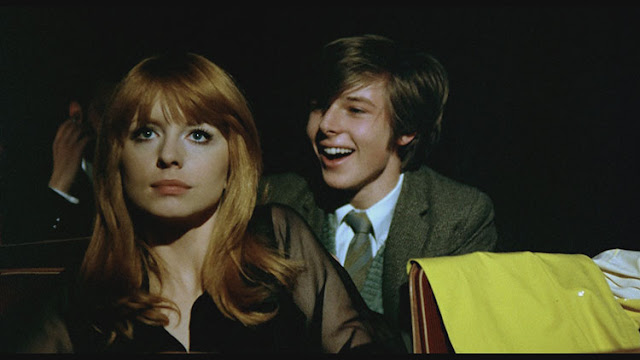
Jerzy Skolimowski’s marvelous and unknown treasure Deep End has enjoyed a cult following ever since its initial release over 40 years ago. The film concerns a 15-year old boy, Mike (John Moulder-Brown), who has just started working in a public bathhouse as an attendant. The only other attendant at the bathhouse is Susan (Jane Asher), a sexy, slightly older girl who Mike falls in love with. Released in 1970, Deep End is an unjustly neglected film that is now beginning to receive the recognition it has long deserved. The film is finally out on DVD and Blu-Ray through BFI, and received repertory screenings in London and New York this year.

A highly influential coming-of-age drama, Deep End also features a cool soundtrack comprised of mostly psychedelic rock that permeated British culture in the late 1960s, mixed with softer music a la Cat Stevens. Reminiscent of the seminal French and Italian new wave pics of the era, Skolimowski’s depiction of adolescent hormones gone wild is tender yet humorous.


The film’s stand out is Asher, that redheaded Beatles-muse that was once engaged to Paul McCartney in the mid-60s. Her character in the film is shallow, yet seductive. And Mike’s naivety falls prey to her fiery ways. He begins to stalk her, and follows her to the movie theater on a date with her fiancé in a particularly humorous sequence, which involves a dozen hot dogs, a cardboard cutout of Asher, an X-rated film called The Science of Sex, and a prostitute with a broken leg. The actors were given freedom to improvise and the results are golden, as the two protagonists, despite a gap in age and personality, enjoy great chemistry together onscreen.

Co-writer and director Skolimowski cut his teeth working on projects with fellow Polish filmmaker Roman Polanski and even shares writing credit on Polanski’s brilliant debut, Knife in the Water from 1962. Skolimowsky followed it up with this British/West German production and continues to make small-market films to this day.


Everything about this quietly ambiguous, yet profound film–-the photography, the imagery, the music--feels vibrant and alive in a way that makes most modern coming-of-age movies look formulaic and of little depth. Four decades after its release, Deep End remains a quirky if disquieting film from the Polish new wave. The tragic ending is one of cinema’s most visually appetizing, and most memorable. And just try not falling in love with Asher after watching the film! She is sublime, and Deep End remains the finest work of her career.

Sunday, December 11, 2011

HOUSE OF PLEASURES (BERTRAND BONELLO, 2011)

House of Pleasures, France, 2011
Dir: Bertrand Bonello
Cast: Alice Barnole, Iliana Zabeth, Jasmine Trinca


2011 saw many independent and foreign films go mostly unnoticed with major audiences. If it was something from overseas or independent, and it wasn’t called The Artist or Beginners (both overrated), then it probably wasn’t going to make it with audiences in American theaters. Instead, moviegoers preferred Transformers 3: Dark of the Moon, and Harry Potter Part 7 Part 2, both of which grossed over $350 million in the US.

Turning the attention away from those blockbusters and sure-to-win-come-awards-time films, it is worthy to note a little-known French film by veteran Bertrand Bonello.

Bonello’s fifth feature-length film, House of Pleasures, is that rare type of film--both shocking and disturbing to the eye, yet provocative and intriguing enough to captivate you. Based on a screenplay written by Bonello himself, House of Pleasures takes place entirely in a Parisian brothel at the turn of the 20th Century. Its inhabitants vary from naïve teenagers who seek independence from their families and girls in their late 20s, already considered old and brittle. Each girl has a sad story to tell, each with enormous debts forced to pay them off by living and working in the house. Life is difficult for the prostitutes. They have no future, no hope. Their debts will never be paid off. Some will catch fatal diseases, which is unavoidable; others suffer a fate far worse--mutilation and lifelong humiliation. A client assaults one girl so badly that she ends up with the nickname “The Woman Who Laughs.”


The movie was immediately written-off by critics after its premiere at the Cannes Film Festival in May. It is difficult for critics to praise the film, since it consciously resists definition and meaning by traditional standards. It is a shame though, because House of Pleasures is worthy of an audience outside of the art house crowd. From the start, the film draws you in with sensuous, ethereal imagery. Helmer Bonello's self-penned score alongside use of playfully old-fashioned soul music and 1960s rock tunes infuse a modern sensibility that keeps the period flavor from becoming overly sentimental.

It should be noted that Bonello never seems to resist alienating his audience, forcing the viewer to squirm in their seat, yet the landscape is so exquisite and stylish that they cannot turn away completely. House of Pleasures, also known as House of Tolerance in the United States, is a brave, titillating and unrelenting work of art. While it may not please a wide range of audiences, the film retains an odd appeal, which might explain its strange effect on the viewer. Bonnello does a great job in creating a beautifully constructed alternative art film. It stands as the one of the finest motion pictures of the year, and certainly the most underrated.

Saturday, December 3, 2011

COMEDY IN DRAMA -- COMEDIANS AND SERIOUS ROLES


I have long had a fascination with comedians in dramatic roles. They are rare but usually brilliant. There is Art Carney who won an Oscar for Harry and Tonto in 1974. Richard Pryor gave a great performance in Paul Schrader’s Blue Collar in 1978. The last 25 years however have brought us some of the best performances from the unlikeliest of actors. In 1984, Bill Murray had already scored hits with Caddyshack and Stripes before exploding with Ghostbusters (and its subsequent sequel released a few years later). But in 1988, Murray decided to star in a black comedy directed by Richard Donner, Scrooged, a variation on Charles Dickens classic tale of A Christmas Carol.

Murray continued making serious efforts at comedy with 1993’s Groundhog Day and 1998’s Rushmore, directed by Wes Anderson. His budding friendship with Anderson led to two other films, 2001’s The Royal Tenenbaums and 2004’s The Life Aquatic with Steve Zissou. Around this time, Murray was courted by Sofia Coppola, cousin of Jason Schwartzman, who co-starred with Murray in Rushmore. At first, Murray declined the role of a jaded celebrity stuck in Tokyo in Coppola’s upcoming Lost in Translation. Eventually however he agreed to star in the film, and won an Academy Award nomination for his performance. He lost to Sean Penn in a controversial Best Actor race. Since then, Murray has starred in several other dramas including Jim Jarmusch’s Coffee and Cigarettes and Broken Flowers.

Other successful comedians in the last two decades have turned to drama after becoming stars in comedy. Jim Carrey won acclaim and two Golden Globes for his performances in The Truman Show and Man on the Moon in the late 90s. He also starred in The Majestic, an underrated 1940s tale directed by The Shawshank Redemption filmmaker Frank Darabont. Carrey also starred in the Oscar-winning Eternal Sunshine of the Spotless Mind, before turning in a poorly received performance in the 2007 thriller The Number 23.


Will Ferrell, who first found fame on Saturday Night Live, and continued his hot streak as America’s favorite comedy star with films like Old School and Elf, experimented with drama in Woody Allen's Melinda and Melinda in 2004 and Marc Forster’s Stranger Than Fiction in 2006. He has since gone back and forth between comedy and drama, making silly comedies like Step Brothers and The Other Guys, and more independent fare like Everything Must Go earlier this year.

Another example of a great comic who has recently starred in dramas is Steve Carell. Carell first found success in 2005 both on TV with The Office and on the big screen with The 40 Year Old Virgin. He also starred in the highly acclaimed and Academy Award winning Little Miss Sunshine, in which he played a gay, suicidal uncle. Most of these actors gave brilliant performances, particularly Murray in Lost in Translation and Carrey in both The Truman Show and Man on the Moon (he portrayed deceased comic Andy Kaufman in the latter). However, the reception to their performances was mixed. Murray is the only one who received so much as an Oscar nod for his work.

There is also Adam Sandler, who was unrecognizable in Paul Thomas Anderson’s Punch Drunk Love in 2002. Sandler was also interesting in Judd Apatow’s Funny People, in which he played a foul-mouthed comedian who learns he has only months to live. It was a shrewd and dark comedy that did not achieve the same reception as Apatow’s previous, more traditional comedies like The 40 Year Old Virgin and Knocked Up. Filmmakers typically known for comedy have also given a try at dramas. In 2005, Woody Allen directed Match Point, a Dostoyevsky-ian thriller set in London. The film was a departure from the romantic comedies that made him famous, but was received well by audiences and critics. He directed another thriller in 2007, Cassandra's Dream, starring Ewan McGregor and Colin Farrell.


Currently, several funnymen are transitioning into drama. Jonah Hill, of Superbad fame, recently starred in Moneyball with Brad Pitt about the Oakland Athletics baseball team of the early 00s. The film was written by Oscar-winners Steven Zailian and Aaron Sorkin and directed by Bennett Miller. And it’s not just the gentlemen who are making waves as comics turned serious actors. Comedienne Monique won praise and an Academy Award for Precious in 2009.

What is it about seeing an actor most associated with films filled with laughter playing a role that fills you with sadness that is so intriguing? Is it because we expect him to make funny faces but instead portrays a thoughtful and solemn character? If that’s the case, then that might be the exact reason why the films receive a lukewarm reception from critics and audiences. No, the real reason the movies don’t receive the proper level of recognition is different. The real reason is that most actors are only adept to one genre throughout their careers. And when Jim Carrey shows his face in a drama, the drama people tune in, and the comedy people tune out.

The only thing is, the comedy people outnumber the drama people five to one in this country, so less people see the dramas. Or, maybe, I’m wrong. Maybe it is just very strange to see an actor who is always funny and making you laugh now try to make you feel something more emotional and complex. Maybe, we as audiences are programmed for certain kind of films and actors. Marlon Brando probably wouldn’t have made a very good comedy actor. So we probably don’t want to see Ace Ventura in a serious film either. Perhaps that is the most perplexing thing of all -- the vast psychology of the average moviegoer.

Wednesday, November 2, 2011

DARLING (JOHN SCHLESINGER, 1965)

Darling, UK, 1965
Dir: John Schlesinger
Cast: Julie Christie, Dirk Bogarde, Laurence Harvey


Darling
is cool, and raw and cold in its depiction of sexuality, both hetero and homo. It is aided by a brilliant and witty script by writer Frederic Raphael. John Schlesinger, who later won an Academy Award for Best Director for Midnight Cowboy, directed Darling. The cast is a special one, headlined by Julie Christie, who also starred in David Lean’s epic Doctor Zhivago during her star making year of 1965. The film also stars Dirk Bogarde, as her love interest, and Laurence Harvey as a charming young London socialite.

The film won three Academy Awards in 1965 including Best Actress for Christie and Best Screenplay for Frederic Raphael, an American-born, British-educated screenwriter who would later pen Two For the Road, and most recently Stanley Kubrick’s final film Eyes Wide Shut. Darling became notorious for describing the urban way of life for London’s rich and famous.

This was precisely the time when films were radically changing across the globe. Jean-Luc Godard and Francois Truffaut in France, Bernardo Bertolucci in Italy, Roman Polanski in Poland, Milos Formas in the Czech Republic, Andrei Tarkovsky in Russia, and filmmakers like Mike Nichols and Dennis Hopper were making headlines in the United States for their radical approaches to film as well. Meanwhile, England also saw a new wave of young filmmakers who were making groundbreaking pictures such as Tony Richardson’s Tom Jones and Lindsay Anderson’s If… in addition to Schlesinger whose career in movies began in the 50s, as an actor.


Darling
was his first international success as a director and it helped him land Midnight Cowboy, when Hollywood began knocking on his door. Darling features a brilliant cast, and Christie excels as a bored, young and naïve girl hungry for stardom and happiness. Released during a period known as the swinging 60s, Darling was a perfect film for its time. Raphael’s script seamlessly builds a foundation for characters that are shallow, yet vulnerable and complex. The film perfectly personifies London in the 1960s. The film says a lot about the illusions of glamour and fame that women are compelled to fulfill.

Darling is still as timely today as it was then, since there are still so many women who cling to the images and myths of ideal womanhood, and whose goals lead them to believe that social climbing will lead to happiness. Our own era has an even more all-pervasive cult of celebrity than the ‘60s did. Darling was a quasi-landmark film. It introduced to the world one of the finest stars of the 60s and 70s. It also paved the way for more provocative dramas, shooting in masterful black and white for more flavor and feel. Darling remains an underrated classic nearly 50 years after its release.

Saturday, October 29, 2011

LIKE CRAZY (DRAKE DOREMUS, 2011)

Like Crazy, USA, 2011
Dir: Drake Doremus
Cast: Anton Yelchin, Felicity Jones, Jennifer Lawrence


We've all been there. We meet the right one. Then we lose them, but only for a short while, then we get back together, and then one of us fucks up and we lose each other for good. Hollywood drums up a similar tale, Like Crazy (as in “I love you like crazy"). The film is being released this weekend in select cities across the U.S. and is directed and co-written by 28-year-old Drake Doremus, who based many parts of the film on his own failed marriage experience.

It has become a tradition that the winner of the Grand Jury Prize at the Sundance Film Festival receives monumental attention, including a theatrical release, and in recent years, multiple nominations at the Academy Awards. In 2006, Indie darling Little Miss Sunshine won two Oscars and grossed over a $100 million domestically. In 2009, Lee Daniels directed Precious, which earned him two Oscar nods and was one of the most critically acclaimed releases of the year. In 2010, Winter’s Bone, which also won the top prize at Sundance garnered great reviews upon release and was nominated for four Academy Awards. So it comes as no surprise that this year’s best film as voted by the Sundance jury gets its share of kudos and acclaim now that the awards seasons has begun. Like Crazy, starring Anton Yelchin and Felicity Jones as Jacob and Anna, is a typical love story told in a refreshing and intimate way.


Yelchin and Jones excel as a couple that are kept apart by immigration laws and secret affairs and they help create an absorbing and touching love story. Many parts of the film, however, were improvised. Director Drake Doremus said he often left the camera rolling for up to a half an hour at a time just to capture the two together. As the pair is torn apart by distance and time, the film grows sparser and more pained, the uncertainty between Jacob and Anna more obvious. The film also features Jennifer Lawrence, who plays Samantha, Jacob’s secretary and on again/off again girlfriend.

Like Crazy
was produced far outside the Hollywood studio system for just $250,000 and surprised everyone when it became an unexpected sensation at this past year's Sundance Film Festival. The project was a true collaboration. Director Drake Doremus and Co-Writer Ben York Jones put together a 52-page outline for the movie, creating characters very loosely based on their past long-distance relationships. Once they cast Yelchin and Jones, they gave the actors room to bring the script to life with improvisation that created its own unique reality.


The film beautifully illustrates and explores the complex fragility of first love. After an impressive effort from a group of extremely talented 20-somethings, one is eager to see what the future holds for the artists and performers involved. Like Crazy might not be the most talked about movie of the year, but it is certainly one of the best films you’ll see all year.

Saturday, October 22, 2011

POISON (TODD HAYNES, 1991)

Poison, USA, 1991
Dir: Todd Haynes
Cast: Edith Meeks, Evan Dunsky


The Sundance Film Festival has long been known as a breeding ground for up and coming filmmakers. It is the elite gathering of the best independent films from the U.S. and around the world. Among the festival alumni include some of the best-known filmmakers of today, such as Jim Jarmusch, Steven Soderbergh, Quentin Tarantino, Darren Aronofsky, and Christopher Nolan. Most of them rose to fame in the 1990s, which was a decade that can be characterized as being the time period when film transitioned from the emergence of the franchise movie in the 80s to an independent haven with dozens of small-studio production and distribution companies, most of which did not survive the decade other than the most successful ones like Miramax and Fox Searchlight.

In 1989, provocative, queer-themed director Todd Haynes had just finished Superstar, a 40-minute dramatization of Karen Carpenter’s life starring Barbie dolls in place of actors. The film was a big underground success, and the summer after its release, Haynes and his producer Christine Vachon began working on their first feature together, Poison, based on the novels of renowned poet and scholar, Jean Genet.


The 1990s played host to dozens of groundbreaking, and brilliant movies directed by 20-somethings with little or no money at all at hand. Haynes was wittingly or unwittingly now part of a movement. The same independent movement that would produce films like El Mariachi, Clerks, Spanking the Monkey, Welcome to the Dollhouse, Swingers, and Pi. Todd Haynes’ Poison is an excellent example of the quality of the work that was being produced during this period.

The film is told in an unconventional manner with a trio of rotating story arcs, distinguished in the credits as “Hero,” “Horror,” and “Homo.” Completely unrelated to each other, the segments deals with a different subject, in different genres. “Hero,” told in mockumentary-style, centers on a small town that is recovering from the strange disappearance of a boy who killed his father. “Horror,” the only segment shot in black and white, is an homage to 1950s paranoid thrillers about a scientist who becomes infected with a disease after drinking a potion he was working on. The final story, “Homo,” is perhaps Hayne’s most personal. It deals with a prisoner in 1940s Paris who is haunted by memories of a prison camp he was held in as a youth, where inmates was forced to perform homosexual acts of violence.


The film broke ground for not just gay-themed filmmakers, but independent artists of all backgrounds hoping to break boundaries without the fear of harsh criticism. Poison eventually won the Grand Jury Prize at Sundance in 1991, but was slapped with an NC-17 rating when released in theaters, and was one of the most controversial films of the year. Following his semi-experimental debut, Haynes directed several mainstream films (or as mainstream as Todd Haynes could get) including the 2002 Oscar-nominated Far From Heaven and the HBO Mini-series Mildred Pierce earlier this year.

Hayne’s Poison, his explicit and thought provoking debut, is still a landmark in American independent cinema and an exemplary work of the New Queer Cinema of the 1990s.

Wednesday, September 14, 2011

MENTAL MASTURBATION PART VII


Every so often, I post a list of great films that go unrecognized with casual movie fans. Some are current, some are older, some are domestic, some are foreign, but they're all brilliant movies you should check out if you have a chance.

If a film has a * symbol next to it, that means that the selected choice is an exceptional stand out.

Lifeboat (Alfred Hitchcock, 1944)
Little Fugitive (Ray Ashley, Morris Engel, & Ruth Orkin, 1953)
Shadows (John Cassavetes, 1959)
An Occurence at Owl Creek Bridge (Robert Enrico, 1962) *
Viy (Georgi Kropachyov & Konstantin Yershov, 1967)
The Devils (Ken Russell, 1971) *
Blue Collar (Paul Schrader, 1978)
Das Boot (Wolfgang Petersen, 1981)
Streets of Fire (Walter Hill, 1984)
Return to Oz (Walter Murch, 1985)
The Woman in Black (Herbert Wise, 1989)
Begotten (E. Elias Merhige, 1990)
Quick Change (Howard Franklin, & Bill Murray, 1990)
Proof (Jocelyn Moorhouse, 1991)
Howards End (James Ivory, 1992)
The Age of Innocence (Martin Scorsese, 1993)
The Brothers McMullen (Edward Burns, 1995)
Multi-Facial (Vin Diesel, 1995)
Heavy (James Mangold, 1995)
See the Sea (François Ozon, 1997)
Cube (Vincenzo Natali, 1997)
Bella Mafia (David Greene, 1997)
Flowergirl (Cate Shortland, 1999)
Boiler Room (Ben Younger, 2000)
The Piano Teacher (Michael Haneke, 2001)
Wonderland (James Cox, 2003)
Lymelife (Derick Martini, 2008)
Tyrranosaur (Paddy Considine, 2011)
Bellflower (Evan Glodell, 2011)

Tuesday, September 6, 2011

THE KILLING (STANLEY KUBRICK, 1956)

The Killing, USA, 1956
Dir: Stanley Kubrick
Cast: Sterling Hayden, Marie Windsor, Elisha Cook


The Killing
is a 1956 heist film written and directed by a 28-year old Stanley Kubrick. It was his first studio-funded picture and landed him acclaim from critics and peers all around. It signaled the beginning of a Hollywood career that lasted until his death in 1999.

In 1955, Kubrick was still a young filmmaker from the Bronx, and just completed a mini-featured called Killer’s Kiss. He sold it to United Artists for $75,000 and a promise that his next project would be backed by the studio. Around this time, Kubrick befriended a budding producer named James Harris. The two teamed up and decided on adapting Lionel White’s crime novel Clean Break as their first collaboration together.

Kubrick’s background was in photography, and his keen sense of visuals helped sell Killer’s Kiss. What he lacked though, was a mastery of dialogue and language. Kubrick and Harris then hired notable crime novelist Jim Thompson to help with the screenplay. Kubrick used his deep knowledge of TV character actors to compile an impressive cast that included Sterling Hayden, who later played Jack D. Ripper in Dr. Strangelove, Timothy Carey who starred in Kubrick’s next masterpiece, Paths of Glory a year later, and Joe Turkel who later played the part of the butler in The Shining almost 25 years later. Also notable among the cast is Marie Windsor, who played a devious and heartless femme fatale.


The Killing was completed and released in 1956, although it received very little campaign management from United Artists and the film ended up a flop at the box office. Kubrick, however, landed much praise from critics including Time Magazine and the trio of Harris, Kubrick, and Thompson landed an opportunity to make Paths of Glory, a powerful and visceral World War I drama starring Kirk Douglas, who was impressed with The Killing and wanted to work with the creative team behind it.

Fifty-five years later, the film’s influence and attraction is still heavy in weight. In 2011, The Criterion Collection honored The Killing with a special edition release with interviews featuring Harris, as well as a TV special with Sterling Hayden from 1984, just before his death.


The Killing tells the story of Johnny Clay, a recently released con artist who orchestrates a racetrack robbery with several employees of the track.

Modeled after Akira Kurosawa’s classic film Rashomon, the story unfolds in a unique and stylized non-linear fashion, essentially telling the same story several different times from several different perspectives. This approach would later influence many films including Quentin Tarantino’s Reservoir Dogs and Steven Soderbergh’s Ocean’s Eleven.

Kubrick eventually became a force in the movie industry, scoring 13 Oscar Nominations for films such as 2001: A Space Odyssey, Barry Lyndon and Full Metal Jacket. When considering his legacy, few tend to think of his early work like Killer’s Kiss, shot entirely on location in New York City, and The Killing, one of the last, great true film noirs. Only 84 minutes in length, the film is deliberately fast-paced and consistently suspenseful until its ironic, bittersweet conclusion.

The Killing
remains one of the best noir films of the 1950s. Full of surprises and great characters, it’s a highly inspired and brilliant piece of filmmaking.

Sunday, September 4, 2011

WHO WAS RAÚL JULIÁ?


Who Was Raúl Juliá?

He was an actor, born in Puerto Rico in 1940. He stood out in his classroom and began theater in his teens. In 1971 he landed a role in the cult film The Panic in Needle Park, Al Pacino’s first starring role. He worked with Meryl Streep on Broadway in the 70s, and starred in the 1985 milestone independent film Kiss of the Spider Woman, which won co-star William Hurt an Academy Award for Best Actor. In 1994, he landed the antagonist role in the big screen adaptation of the popular Street Fighter video game series. He never saw the release of the movie after experiencing a stroke in the fall of 1994, just before the expected release date.

Today fans know him as many things. His most popular film role was that of the patriarch of the Addams Family in the successful Addams Family films, released in 1991 and 1993. As Gomez Addams, Julia headlined the beloved franchise, and no doubt would have spearheaded a continuation of the series had he not passed away so suddenly a year after the release of The Addams Family Values, number two film in the franchise.


Seventeen years after his death, admirers of Julia’s still reminisce about his wonderful theater days in the 60s and 70s. Others remember his bold and poignant performances in several films now regarded as classics of their time.

Born to a wealthy Puerto Rican family, Julia moved to America in 1964. By the late-60s, he was appearing on Broadway and during the 70s he was one of the biggest stars on stage, with Tony nods for his performances in Two Gentlemen of Verona (1972), Where's Charley? (1975), Threepenny Opera (1976) as well as Nine (1982), which was eventually turned into a feature film in 2009 starring Daniel Day-Lewis in the role Julia performed on stage.


Raul Julia always had a knack for playing strong, determined, and complex characters both on stage and on the silver screen. He was a pioneer for Hispanic actors, and became one of the most beloved screen stars in Hollywood. Julia spent his career performing along with some of the greatest actors of his generation, including Robert Redford, Meryl Streep, Harrison Ford, and Al Pacino. He also worked with the top filmmakers of the 70s and 80s like Francis Ford Coppola, Clint Eastwood, John Frankenheimer, Alan J. Pakula, Sydney Pollack, Paul Mazursky, and Robert Towne.

Although never making it into the mainstream realm of stardom, he sustained a busy screen career; he appeared in nine films released between 1988 and 1990. His decision to take a role in Street Fighter was an attempt to connect with a younger audience. However, during filming, he suffered a stroke and passed away in October of 1994, at the peak of his career. In an ironic twist, Julia won a Golden Globe Award for Best Actor in a TV Miniseries, posthumously, for The Burning Season. His funeral was held in his birthplace of Puerto Rico, which was attended by thousands. He was 54 years old and left behind an unfinished legacy of work, still admired to this day.